News

Digital innovation, how do you start with a digital idea?
Digital innovation starts primarily with a different way of looking at things, by asking yourself questions. Not with the ambition ‘to do something with digital,’ or with the technology itself, but with curiosity about whether digital is the solution to a particular problem.

How cybersecure is the cultural sector? Participate in our research
Museums, libraries, stages, and archives often work with online systems, digital collections, and audience data in 2026. But how well are cultural organizations actually prepared for the digital risks that come with this? To gain clarity, we at DEN are launching a new nationwide Cybersecurity Scan. And we need you for this: the more organizations participate, the more accurately we can map the current state of affairs together.

AI and Cybersecurity: What Changes for Your Organization?
What sounds like science fiction happened this year. AI is making cyberattacks faster, more convincing, and more scalable. The good news: the same technology also enables the detection of vulnerabilities and faster handling of incidents.
This is important for museums, libraries, and other heritage institutions: almost every organization stores personal data of visitors or members. After a hack, you may not be able to continue your operations, or you run the risk of losing a valuable collection.
In this article, we update you on these developments, explain what changes for your organization, and provide steps you can take today to protect against external attacks.

Sustainable digitalization as the norm
On September 28, the NCDD presented a renewed manifesto: ‘Sustainable digitalization as the norm’
With this, the National Coalition for Sustainable Digitalization calls on public and private organizations to structurally implement sustainable digitalization in practice.
The renewed Manifesto for Sustainable Digitalization 2027-2030 was handed over during the NCDD conference by Hannah Boute to Michiel Boots, Director-General of Economy and Digitalization at the Ministry of Economic Affairs and Climate Policy.

Wat niemand ziet, weegt het zwaarst: uitkomsten onderzoek naar verborgen digitaal werk
Wie in een culturele organisatie digitaal werk doet, herkent het patroon vaak maar al te goed. Een functie die ooit met een duidelijke taakomschrijving begon, groeit in korte tijd uit tot een veelvoud daarvan. Collega's die inspringen op systemen die niemand anders begrijpt, vragen beantwoorden die buiten elk functieprofiel vallen, werk verzetten dat nergens in een jaarplan terugkomt. Dat werk is essentieel voor de organisatie, maar voor de mensen eromheen vaak onzichtbaar. En onzichtbaar werk voelt zwaarder, juist omdat het niet wordt gezien of erkend, wat op termijn frustratie oplevert en digitale professionals uitput.
Design Thinking: human-centered thinking in five steps
You can apply Design Thinking when carrying out your digital projects. It is often seen as something for designers, but managers, policymakers, and other professionals also work with it. The approach combines a human-centered mindset with a concrete, step-by-step method that ensures your projects become more successful. In this article, we explain what Design Thinking is, how the five phases work, and how you, as a cultural professional, can use it.
Workshop: Impact Thinking and Measuring
You want to make an impact as an organization. But what change do you actually want to achieve? For whom? And how do you know if your approach contributes to that?
In this one-day workshop, you will practically work on impact thinking and measuring. Using your own projects, programs, or activities, you will explore what change you want to achieve and how to make it visible.
Cookies on your website: what is allowed and what is not according to the GDPR?
Almost every website uses cookies: small files that remember data from your visitor for a subsequent visit. Useful, but your visitor must be able to decide which data that is. What rules apply to this, and how do you set it up properly for your organization?
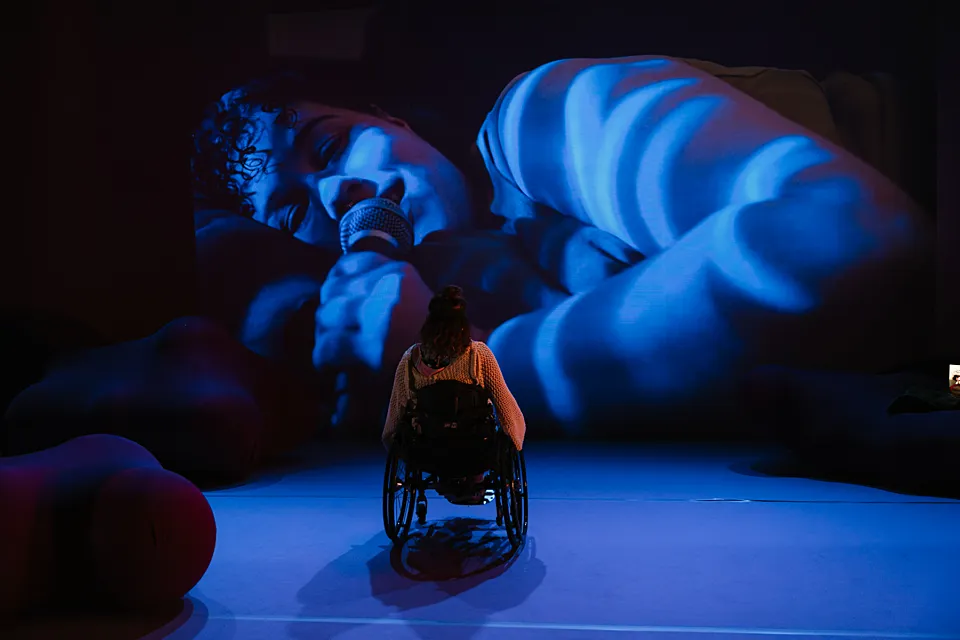
Accessible Theater: How Speels Collectief Uses Livestreaming to Engage Everyone
Do you want to reach a new, more diverse audience as a cultural organization? Streaming proves to be an effective tool to engage homebound and/or stimulus-sensitive audiences. In the play 'Content warning: few stimuli' by the theater company Speels Collectief, two actors participate digitally, while viewers are both present in the theater and watching online.
What does such a digital approach require from an organization? Director Sanne Arbouw talks about the rehearsal process, how digital tools bridge the gap to people who cannot be physically present, and what it brings to both creators and the audience.