In brief
Starting August 2, 2026, cultural organizations are required to label AI content in two situations: for deepfakes and for fully automated published texts. If you use AI with editorial control by a human or for artistic work, an exception applies. A recognizable label must at least contain "AI" in uppercase letters and be directly visible alongside the content.
What is the Code of Practice on Transparency of AI-Generated Content?
Code of Practice on Transparency of AI-Generated Content: we repeat the term once more. It’s a mouthful, but worth delving into. While the AI Act outlines the main principles, this provides a concrete implementation. The AI Act mandates that you must be transparent about AI usage. The new Code of Practice on Transparency of AI-Generated Content specifies how to do that.
The code consists of two parts. The first part focuses on companies that build and market AI systems. The second part focuses on entities that use AI to create or publish content. In the law, such an entity is called a deployer, meaning an organization or creator that uses an AI system. As you might expect, this second part is particularly relevant for the cultural sector.
When are cultural organizations required to label AI content?
Not all uses of AI fall under the labeling requirement. The code focuses on two specific situations.
Deepfakes. A deepfake is AI-generated image, audio, or video that is so realistic it appears genuine, imitating existing people, places, or situations. Think of an AI reconstruction of artist Dalí greeting you in the Dalí Museum in Florida (opens in new tab) or a widower engaging with an AI reconstruction of his deceased wife in an NTGent theater production (opens in new tab). Those who create and publish such work or content are required to clearly indicate that.
AI-generated text for the public. You are also required to label when writing texts to inform people about current or societal topics and publishing them without human oversight. Examples include a fully automated newsletter or a chatbot publishing messages without editorial control.
What are the exceptions to the labeling requirement?
There are several, but two are relevant for the cultural sector.
Editorial control. If you use AI as a writing or imaging aid but a staff member always reviews the content before it is published, you fall outside the labeling requirement. The editorial responsibility then lies with a human.
Artistic and creative work. A deepfake that is part of a theater production, art installation, digital art installation, or satirical work does not need to contain a label within or during the work. However, in the immediate vicinity—such as accompanying text, program booklet, subtitles, or credits—it must be mentioned that the work was created using AI. This preserves the artistic experience while still informing the audience.
What does an AI label look like?
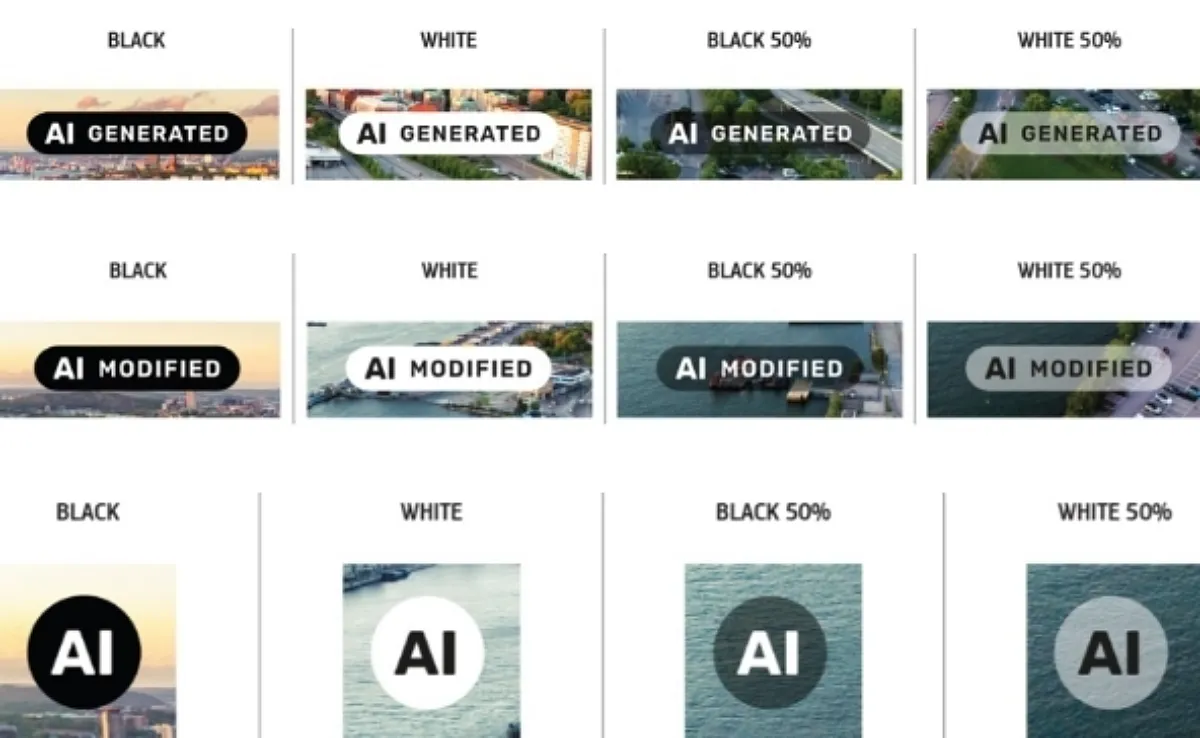
The code specifies requirements and provides tips on what a recognizable label should look like. The EU has developed its own logo for this purpose, but you may also use a custom logo that meets the same criteria. The main points are:
Requirement 1: The label must at least include the text “AI” in uppercase letters.
Requirement 2: The label must be clearly visible and recognizable to everyone, including children, elderly people, and individuals with disabilities. Ensure sufficient color contrast and compatibility with screen readers.
Tip: Additionally, the label may include other words, such as “Created with AI” or “AI-generated”.
For inspiration: below is the logo developed by the EU: "AI GENERATED" for fully AI-created content and "AI MODIFIED" for modified content.
Where should I place the AI label?
The label must be visible at the moment someone first sees or hears the content. For text, this is at the top of the text, for example, before or after the title. For video, this is at least at the beginning and additionally recurring regularly (at least after an interruption such as advertising). For audio, this is a spoken disclaimer at the beginning of the fragment.
Four questions to ask within your organization
In addition to the label, the code also requires internal organizational measures. Ask yourself the following questions:
Do we publish deepfakes or fully AI-written texts?
Who in our organization is responsible for the final content that goes public?
Do our employees know when an AI label is mandatory?
Who is responsible for correct labeling?
Document the answers to these questions in an AI policy (opens in new tab) under the theme of Transparency. Transparency about AI usage is not only a legal obligation. It is also a matter of trust with your audience: showing that you handle new technology responsibly and transparently.
Frequently Asked Questions
Do I need to place an AI label if I use ChatGPT to improve a text?Hide explanationShow explanation
No. If you use AI as a tool for writing and a staff member reviews the text before it is published, the editorial exception applies, and you are not required to label. The final responsibility lies with a human.
Does the labeling requirement also apply to images I generate with AI for social media?Hide explanationShow explanation
It depends. If it is a realistic image imitating existing people, places, or situations, it is a deepfake, and you are required to label it. If it is a clearly abstract or illustrative image that imitates no one, it falls outside the deepfake definition, and no labeling requirement applies.
What happens if I don’t place an AI label when it is required?Hide explanationShow explanation
The Code of Practice falls under the enforcement of the AI Act. Violations can lead to fines. The exact enforcement per member state is still being developed, but the obligation itself applies from August 2, 2026.
Does an AI chatbot on our website need a label?Hide explanationShow explanation
Yes, if the chatbot informs visitors about current or societal topics without editorial control. If the chatbot answers practical questions (opening hours, directions, ticket prices), this falls outside the labeling requirement.


More articles per topic