PHI Factory is a consultancy firm that helps organizations accelerate toward a circular and inclusive economy and encourages them to become regenerative. Joost Droste is a sustainability advisor at PHI Factory and previously conducted research for DEN into the environmental impact of streaming at the Festival Oude Muziek Utrecht and the Nederlands Dans Theater (NDT). This resulted in an initial calculation tool.
For the in-depth research into the CO2 emissions of streaming and physical performances, the environmental impact of the digital performance ‘The Shell Trial’ by Nationale Opera & Ballet (NO&B) was measured. “The goal was to investigate more precisely what happens during the streaming of a performance,” says Joost. “That’s why I had to delve deeper into how the digital ecological footprint of streaming is formed.”
He continues: “We found answers to questions such as: what exactly does the environmental impact of online streaming consist of? Which elements are decisive in determining emissions? What are plausible, current sources?” Together with DEN and Julie Fuchs, sustainability coordinator at NO&B, he collected and analyzed diverse data about the creation of an online performance.
The findings are documented as accurately as possible in the Whitepaper CO2 Emissions Streaming/VOD 2025. This publication provides a technical foundation for our figures.
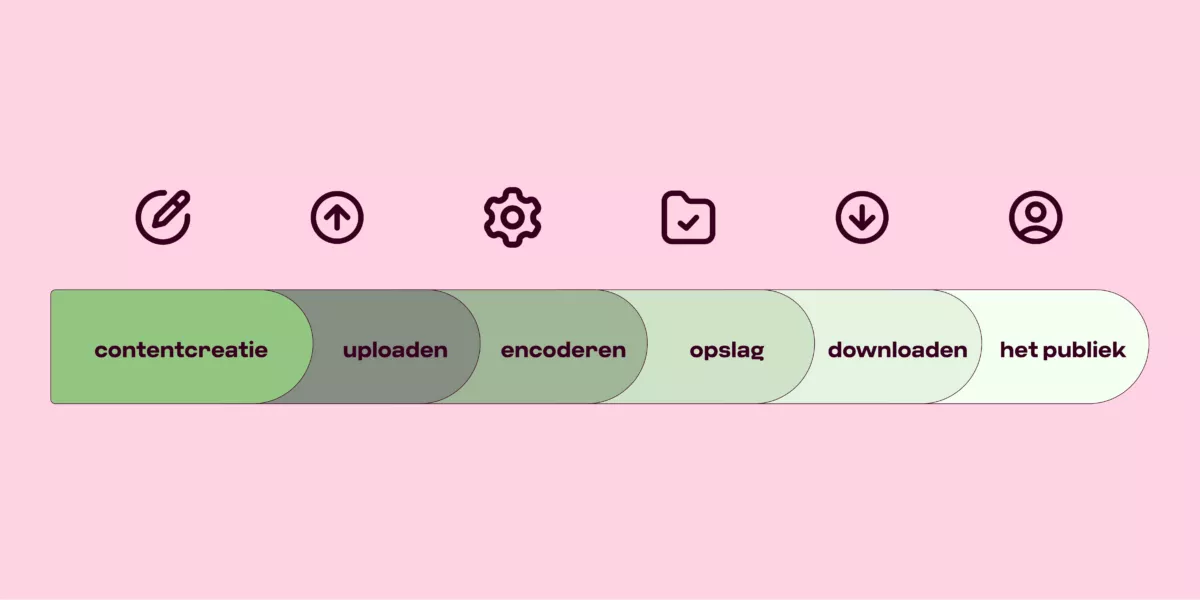
Phases in streaming: from production to viewer
When streaming performances, six phases are involved:
- Content creation (recording and editing)
- Uploading to a data center
- Encoding (converting to various resolutions)
- Storage in the cloud
- Downloading by the audience
- Playback by the viewer
“Each phase contributes to the total CO2 emissions, but some phases have a larger share than others. The largest environmental impact lies in downloading and playing the video files by the audience. This results in high data usage and thus relatively significant emissions.”
There is a significant difference in emissions between live streaming and video on demand (VOD). “Live streaming consumes an estimated three to five times more energy per viewer than VOD,” explains Joost. “While VOD requires more permanent storage capacity, it still consumes much less energy than live streaming. This is because, during live streaming, video fragments are encoded in real-time at the data center into various resolutions. This requires high computing power, as each new minute of content is processed on the spot. As a result, energy consumption per viewer is higher for live streaming than for VOD from a recording, where the processing occurs only once.”
Additional emissions online
Regarding the difference in environmental impact between online streaming and physical performances, the results barely differed from previous measurements at the Festival Oude Muziek Utrecht and the NDT.
Joost: “Namely, the additional emissions from streaming turn out to be very low. At Nationale Opera & Ballet, the added emissions for the VOD were less than 1% of the total. Quite sustainable! At the previously measured organizations, emissions for digital performances were less than 3%.”
Joost also praises the sustainable set design choices made by NO&B for the physical performance. “The set would have been a much larger share if everything had been made from new materials. By opting for reuse and recycling, Nationale Opera & Ballet significantly reduced the physical footprint.”

Measuring the ecological footprint
One of the biggest challenges in researching the environmental impact of streaming, according to Joost, is the limited transparency of data centers. “They share little information about their ecological footprint. This makes it difficult to make an accurate estimate of total emissions. Nevertheless, valuable insights have emerged from the research.”
These insights have led to a renewed and significantly improved calculation tool. “In the previous version of the tool, sustainable design choices could not be included. Since sustainability is increasingly embedded in productions at cultural venues, we added the option of whether new or reused materials were used. Organizations already aware of the sustainability of their materials - for example, because they use the Theatre Greenbook, the Environmental Barometer, or another sustainability tool - can also directly input their measurement results in kilograms of CO2. By choosing for each component whether it involves new or reused materials, it becomes clear how design choices contribute to sustainability.”
Performing arts institutions can use the renewed calculation tool to gain a good understanding of the CO2 impact of their performance. “They see how large the footprint is and which components have the greatest environmental impact,” explains Joost. “This allows them to take targeted measures to reduce that ecological footprint in the future. You can also use the tool the other way around by filling it out in advance and weighing conscious choices. For example, you can see the impact of certain material choices and understand what you can do to make a performance more sustainable, including online. Or you can test what it means for emissions if more people watch online and fewer visitors need to travel.”
Advantages of VOD
Joost considers online streaming a ‘wonderful addition’ to the physical offering. ”It adds value for people with less money, but also for people who are not mobile or are abroad. Nationale Opera and Ballet had viewers from more than fifteen countries, thereby saving a lot of travel kilometers.
Additionally, you can offer something extra online, such as a behind-the-scenes look. Or an online Q&A session, where the audience can ask questions to the cast and director. Sustainability can be an additional reason for cultural organizations to offer online performances. The added value of serving an online audience outweighs the small addition to the ecological footprint.”
How to make streaming even more sustainable?
Cultural organizations aiming to stream as sustainably as possible can, according to Joost, achieve gains by considering peak and off-peak hours in data centers and power plants. “Of course, you prefer to offer streaming services during off-peak hours and upload when a lot of green energy is available. You also have influence over the resolutions you offer. For example, going from 1080p to 4K involves almost one and a half times the amount of data being transmitted. The viewing behavior of the audience - preferably via WiFi and on smaller devices - also affects the environmental impact.”
Joost also emphasizes that this is an estimate based on public figures and not an absolute truth, but an approximation of reality. Additionally, he warmly invites everyone to contribute to the discussion.
Would you like to calculate the emissions of a physical and online performance yourself? Test the new CO2 tool from DEN by contacting: Else Laura or visit phifactory.com/nl/ if you want to develop your own calculation tool together.

More articles per topic