It was recognition that set Sanne on the path to a new form of theater-making. “I am sensitive to stimuli myself and noticed that many people around me struggle with this world full of screens, sound, light, and other stimuli. That recognition was the trigger for this play. And for the question of how theater can become more accessible for creators and audiences who cannot physically come to the theater.”
Actors at a Distance, Equal on Stage
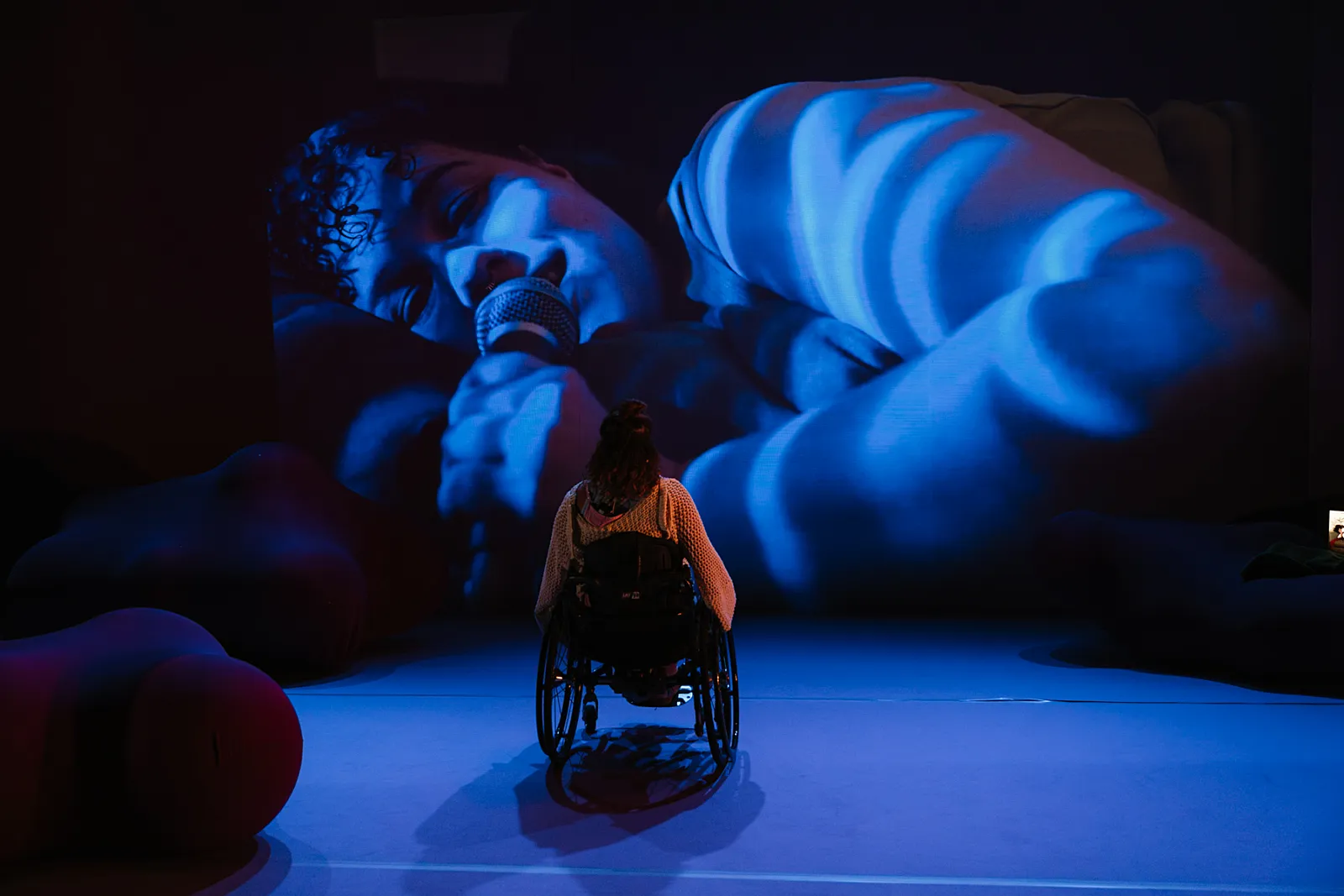
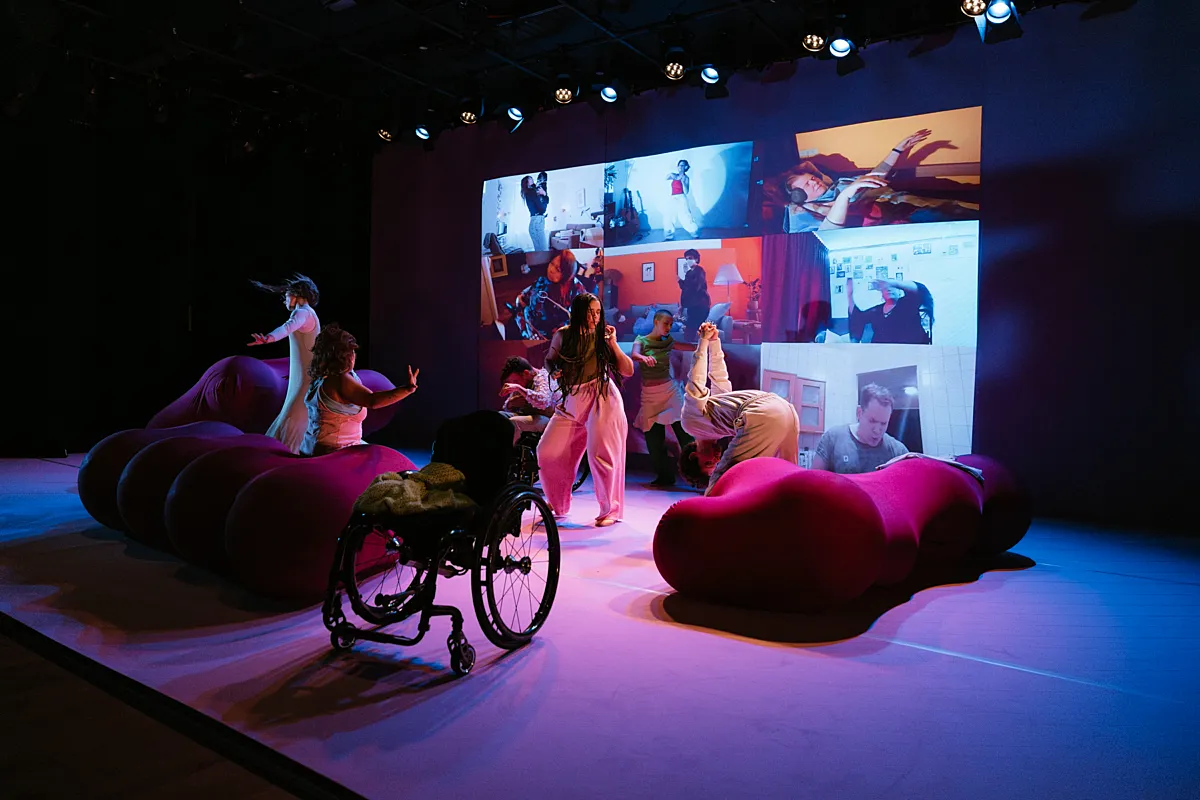
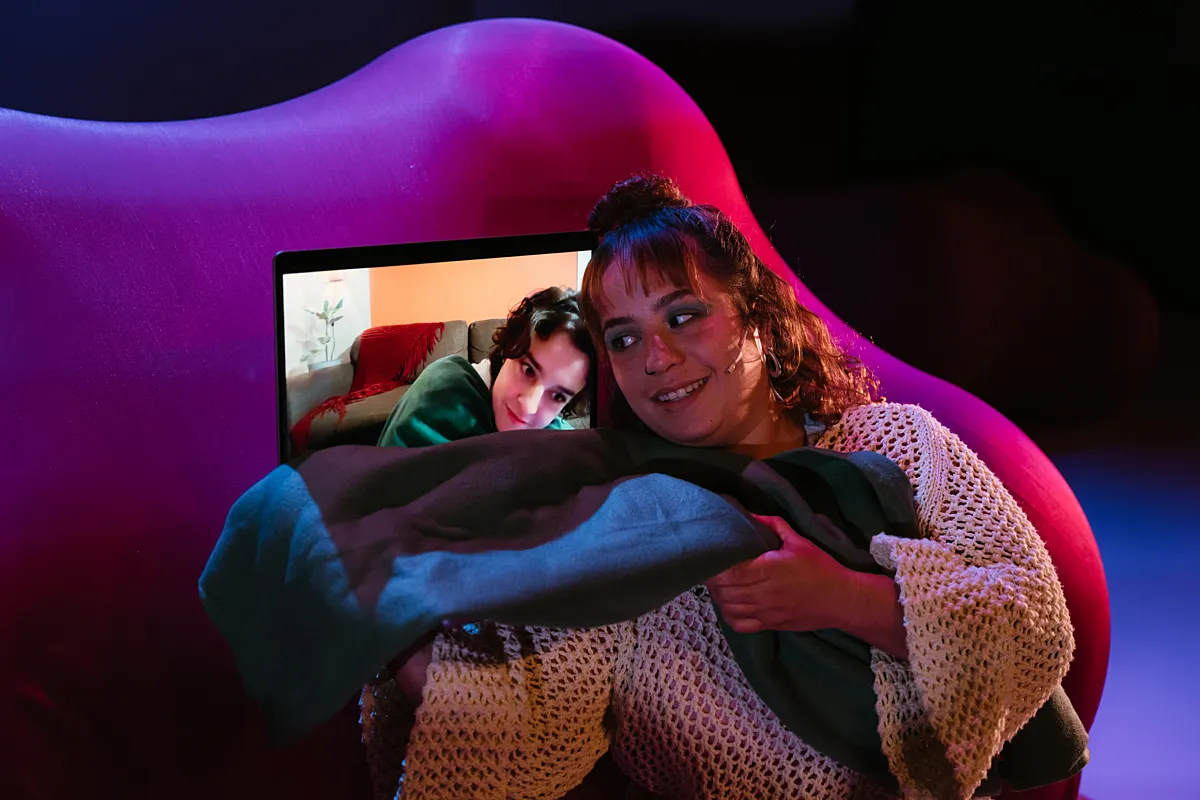
In 'Content warning: few stimuli,' most actors are present in the theater, while two actors participate from their own homes. They are visible to the audience via screens on stage. Rehearsals were conducted via Zoom, with earbuds to hear each other but without seeing each other live. Text and timing were rehearsed down to the second. “It was really a technical puzzle,” explains Sanne. “The scenes with the digital players were pre-recorded, while the rest of the performance is live. Sometimes you think: if only I had timed that a few seconds later. But at a certain point, we decided to record it. That’s what you work with.” The effect that everything seems to happen live was well achieved. “The audience feels like these actors are really dialing in at that moment.”
For the players, the digital approach enables something that was previously impossible. Sanne: “To give an example: we have a musician in our cast who could no longer perform live due to her chronic illness. By making recordings, she found a place to make music again. Additionally, an actor with autism was able to fully participate thanks to digital tools, without the burden of physical rehearsals, travel, and a tour.”
Hybrid Accessibility
The Posttheater in Arnhem is equipped to offer a livestream during theater performances; hybrid, in other words. The recording can be viewed for two weeks. Last year, about 63 people bought an online ticket and watched the stream of ‘Content warning: few stimuli.’ “Upon entering, the audience in the theater always waves to the home audience,” says Sanne, who notes that she doesn’t place much value on numbers. “63 online viewers is fantastic, but it would also be great if it were just five. I find it especially wonderful that we achieve recognition when we create and present a performance inclusively. This brings a lot to people who otherwise wouldn’t attend a performance.”
In addition to audiences with disabilities, Speels Collectief also reaches viewers abroad, the elderly, people with young children, or those with busy schedules through streaming. “It’s not just for people who are sensitive to stimuli. There are various reasons why digital offerings are necessary.”
According to Sanne, digital accessibility tools add significant value. “They bridge the gap to people who cannot be physically present, but they also bring extra creative richness to the creation of a performance. This is called ‘creative access.’ In this approach, accessibility is not an afterthought but an integral part of the creative process. Accessibility thus contributes to a richer cultural language, ensuring an equal experience for and by everyone, including digitally. I advocate for more creative access in the cultural sector.”
Moving Toward an Equal Role for Digital
Speels Collectief plans to further develop its accessible, digital approach. At the end of November, 'Content warning: few stimuli' will be featured at the No Limits Festival in The Hague, the largest inclusive festival for ‘mixed-abled’ theater in the Netherlands, complete with livestreaming, sign language interpreters, audio description for the blind and visually impaired, and a quiet room. Starting January 2027, a tour of ten performances across the country will follow.
Speels Collectief discusses accessibility for stimulus-sensitive audiences with each theater in advance, such as the volume of music in the foyer and dimming the lights. “Moreover, we have our own stimulus guide, so visitors know which stimulus - such as a loud sound - occurs at what moment.”
To enable more interaction, Sanne plans to organize ‘watch parties.’ “These are moments when the home audience watches together, with an introduction beforehand and a discussion afterward, where actors also join. The best would be if online viewers could connect with each other about their digital experience and virtually ‘look at’ each other or chat during the performance. We don’t have that capability yet.”
Furthermore, Speels Collectief wants to expand its online community. “For people who are home- or bed-bound for short or long periods and therefore cannot physically attend lessons, workshops, or performances.”
In 2027, Sanne hopes to create a new performance with one live actor and one actor truly acting digitally in real-time instead of pre-recorded. “Digital actors will no longer be a supplement to the story; they will form the main storyline. We are still looking for a partner to collaborate with because it will be a challenge to make this run smoothly technically.”
Tips from Director Sanne for Cultural Professionals
‘Start with the conversation, not the technology. Accessibility doesn’t have to mean the most expensive elevator in your building right away.’
‘Starting small can already achieve a lot. For example, let one person participate remotely in the rehearsal room, or share a recording with those who couldn’t attend.’
‘No budget for a livestream? Use an existing recording and place it online.’
‘Make your side program digitally accessible too, such as a digital tour of an exhibition or a post-show discussion.’
‘Don’t be afraid your theater will empty out. Those who can attend live will continue to do so. Digital is an addition, not a replacement.’
‘Look beyond the number of viewers. Reaching two people who otherwise could never have come is already valuable.’
About the Director and the Theater Company
Speels Collectief is a diverse, ‘mixed-abled’ theater company founded in 2014 by Sanne Arbouw and Merel van Lieshout. The company has grown into two parts: The Community, a low-threshold space where new creators and students learn to make inclusive theater, and The Company, which produces one performance annually and tours the country with it.
Sanne Arbouw – who herself has been diagnosed with ADHD and autism – forms the management together with Merel van Lieshout and Kir Robben and is one of the directors at Speels Collectief. She creates performances with a diverse group of players with different bodies, minds, ages, and backgrounds to question norms in theater and society. Digital tools help her pursue accessible, inclusive theater.
Want to know more? Visit www.speelscollectief.nl (opens in new tab)
Reaction from an Online Viewer
‘Hopefully, more companies will follow Speels Collectief’s lead and livestream their performances.’
Because she is largely homebound due to illness, Lisa Groot Haar followed the play 'Content warning: few stimuli' by the theater company Speels Collectief via livestream. “I would have preferred to be in the theater, but since my health doesn’t allow it, this was a wonderful way to still attend the piece.”
As a remote viewer, Lisa didn’t feel any less involved in the performance. “It was mentioned that there were also online viewers. The audience in the theater was asked to turn around and wave to us. This made me feel very connected to the rest of the audience. The fact that two of the actors were also only digitally present also created a connection. It broke the hierarchy of ‘offline is more important than online.’”
For Lisa, this introduction certainly leaves her wanting more. “Before I got sick, I was also a theater maker myself. It’s amazing that I can continue to visit my great love – the theater – in this way. Hopefully, more companies will follow Speels Collectief’s lead and livestream their performances.”
The No Limits Festival (opens in new tab), where ‘Content warning: few stimuli' is featured, takes place at the end of November in The Hague.
On November 5, another performance by Speels Collectief can also be seen via a livestream from the Posttheater: IK BEN KAMER 15 (opens in new tab).
More articles per topic